Back to the blog
November 12th, 2026
Hold and Win: how coins that stay in place really work
Hold and Win is one of the most widespread features on recent slots, and several dice slots in the catalogue use it under another name. The idea is simple: certain symbols, usually coins, stay locked on the grid while the empty cells spin again, and every new arrival restarts a countdown.
On screen, it all looks obvious. The questions start when you open the game's paytable: how many symbols trigger the feature, what are the coins worth at your stake, how is the Grand won? This guide walks through the mechanics step by step, works out a full round and separates what the feature genuinely changes from what it is wrongly credited with.
What is a Hold and Win slot?
Hold and Win is not a game type of its own but a feature built into an ordinary slot. The name says it: you hold symbols, and the win comes from piling them up rather than from paylines.
The trigger varies from title to title. On five-reel grids, six special symbols on the same spin are often required. On TaDa Gaming's three-reel grids, one coin per reel, across all three, is enough. Speaking in January 2025, a producer at the studio Evoplay put the usual grid size at between 15 and 20 positions.
Among the dice slots in the catalogue, the feature is easy to spot: coins showing an amount or a multiplier, a respin counter above the grid, and often four symbols named Mini, Minor, Major and Grand.
How a Hold and Win round unfolds from the first coin to the last respin
Once the feature starts, the grid changes. The triggering symbols stay where they are, everything else clears, and only special symbols can still land in the empty cells. These respins belong to the feature: they cost no extra stake.
The counter usually starts at three. A respin with no new symbol knocks it down by one; a symbol that lands sends it back to three and locks in place too. The sequence ends in one of two ways: the counter hits zero, or the last empty cell fills.
The game then adds up every value on screen and pays the total. Whether they show as euros or as multiples of the stake, these values always follow the amount wagered: a 5× coin is worth €5 on a €1 stake, and 50 cents on a 10-cent stake.
One full round in eight respins
Take a fictional example on a fifteen-cell grid, with a stake of 20 cents. Six coins trigger the feature, worth 13 times the stake between them.
- First respin: no coin, the counter drops to 2.
- Second respin: a 2× coin lands, the counter goes back to 3.
- Third and fourth respins: nothing, the counter falls to 1.
- Fifth respin: a Mini symbol worth 15× locks in and the counter resets to 3.
- Three empty respins later, the counter reaches 0 and the sequence ends.
Result: eight symbols on fifteen cells, and 13 + 2 + 15 = 30 times the stake, or €6. A half-empty grid can pay more than expected thanks to a single prize symbol, while an almost full grid pays little if its coins are low. What counts is the value of the symbols, far more than their number.
The four fixed prizes of a Hold and Win game
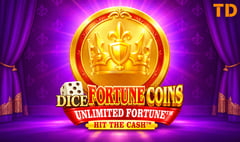
Many coin games mix prize symbols in with the coins. They nearly always carry the same names, from smallest to largest: Mini, Minor, Major and Grand. On Fortune Coins Unlimited Fortune Dice, by TaDa Gaming, these prizes are worth 15, 25, 100 and 1,000 times the stake, a scale the studio repeats across its other coin games.
On many titles, the Grand does not land as an ordinary symbol: it rewards a completely filled grid. TaDa's coin games in the catalogue treat it instead as one of the prize symbols, which can land next to the coins during the respins.
These prizes are fixed: the amount depends on the stake and does not grow over time. A Grand worth 1,000 times the stake comes to €200 on a 20-cent stake, and €2,000 on a €2 stake. Changing your stake therefore changes the cash value of each prize, never the multiples written into the rules. A €2,000 Grand also goes beyond instant withdrawals of up to €1,000 a day: in that case, the whole win goes out by ordinary bank transfer.
That is a different thing altogether from a pot fed by every stake, whose counter keeps climbing until someone wins it. A pot like that changes from one hour to the next, whereas a fixed prize can be read straight from the game rules.
Hold & Spin or Lock & Respin: one principle under other names
Each studio names the feature its own way: Hold and Win, Hold & Spin, Hold the Jackpot, or Lock & Respin at TaDa Gaming. The idea comes from land-based gaming halls. Aristocrat designed Hold & Spin for its Lightning Link cabinet, launched in the mid-2010s with four prize levels from Mini to Grand, before the format settled online.
On top of that base, studios bolt on their own mechanics: multipliers that boost a cell, symbols whose value changes during the sequence, or a grid that expands. Joker Coins Unlimited Fortune Dice brings three of them together. A collector on the middle reel adds up the visible coins, a multiplier can settle on certain cells until the end of the round, and the Unlimited Fortune zone starts on two rows before it widens.
Some of these variants come at a price. On that same game, a stake option adds 50% to every spin to split the collector in two: a spin at €1 costs €1.50 instead, and a hundred spins come to €150 rather than €100. The possible win changes, and so does the spend, which is the line worth reading first. According to the same Evoplay producer, the feature can also sit alongside other game modes with rules of their own, which is why two “Hold and Win” titles sometimes play very differently.
A related family works differently: Collect. On Money Stacks Dice, by Pragmatic Play, a Collect symbol landing on the first or last reel gathers every visible value at once. There is no counter and no respins: everything is settled on a single spin. On screen the two mechanics look alike, yet their pace has nothing in common.
Grid almost full: is the Grand really close?
When only one cell is missing, a full grid seems within reach. In fact, it is the least likely step. Each respin is drawn at random, independently of the previous ones, and the game does not “owe” anyone anything.
A simplified model makes the point. Suppose an empty cell has a 2-in-100 chance of receiving a coin on each respin; the figure is fictional, as no studio publishes its cell-by-cell odds. With nine empty cells, at least one coin arrives within three respins 42% of the time, which restarts the counter. With a single empty cell, the chance of filling it before the counter runs out drops to 5.9%.
The games themselves show how steep the climb is. On Joker Coins Unlimited Fortune Dice, the Unlimited Fortune zone opens on a 3×2 grid and needs ten symbols in place to reach its full size, each new arrival having to land before the counter drops back to zero.
The fuller the grid, the fewer cells are left to restart the counter, so the sequence runs out of steam on its own. Guides that present the full grid as the ultimate goal are right about the amount at stake, not about how often it lands.
Does Hold and Win improve a game's return?
No. Wins from the feature are already part of a game's theoretical return, calculated across every spin, respins included. A spectacular feature does not make a game more generous; it simply spreads out differently what the game pays back.
Several online guides nevertheless present Hold and Win as the feature with the brightest winning prospects, or claim it triggers more often than other special rounds. No general rule supports that: how often the feature triggers and how much of the return it carries vary from title to title, and only the game's information panel can be relied on.
What does come up often is irregularity. When a large share of the result runs through a feature that rarely triggers, a session alternates long runs of ordinary spins with a few sequences that weigh heavily, one way or the other.
Playing Hold and Win online: three habits
First, open the rules panel to check the trigger threshold, the value of the coins and the value of the prizes at the stake you plan to play. Next, try the game in demo mode where it is available, to see how often the feature comes round. Finally, settle the amount for your session before the first spin: waiting for a run of respins easily keeps you playing longer than planned.
Fortune Coins, Joker Coins and the other coin games are ready to play at Dragon Casino, the online Belgian casino licensed under B+3817, where every title's rules can be read before your first stake. The feature can liven up a session, but it never guarantees a win.