Crash Games

















Crash games: the game where you decide when to stop
A multiplier climbs, and you have to cash out before it collapses. A ball drops down a board of pegs. A grid hides traps under some of its tiles. Behind very different looks, the games in this section rest on the same idea: rounds lasting a few seconds, and one decision left to you, namely the moment you stop.
That is what sets them apart from a slot, where the reels decide everything once the stake is placed. Here, you set a target or take your winnings along the way. The question is what that choice genuinely changes, and what it does not.
The principle behind every crash game
Each round starts with a stake, after which the game grows a potential win: a multiplier rising, a path advancing, a ball falling. At any moment, an event can cut that progress short. Until it happens, you can cash out; if it comes first, the stake is lost.
The outcome of every round is drawn by a random number generator and owes nothing to previous rounds. A run of early crashes does not herald a high multiplier next time, and the reverse is no truer.
The section holds sixteen titles from TaDa Gaming, Darwin, BetSoft and Gaming1. Their names often carry the word Dice or Slot, but they fall into four families.
The classic crash game: cash out before the fall
This is the format that gave the section its name. The multiplier starts at 1× and climbs without pause. At a moment nobody can predict, it stops dead. If you cashed out beforehand, you win your stake multiplied by the value reached; if not, you lose the stake.
Most of these games offer auto cash-out: you set in advance the multiplier at which to take your winnings, and the game does it for you, regardless of your reaction time. Depending on the game, the round can even end at 1×, before the multiplier has taken off.
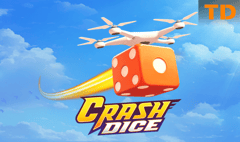
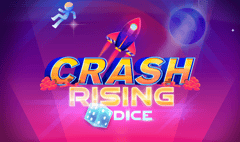
Three titles in the catalogue follow this principle: Crash Dice by TaDa Gaming, Crash Rising Dice by Darwin and Crash Slot by Gaming1.
Limbo: setting your target before the round
Gaming1's Limbo Slot turns the logic around. Rather than watching a multiplier rise, you pick your target before starting the round. The game then draws a result: if it reaches or beats your target, you win at the multiplier you chose.
The higher the target, the less likely it is to be reached. There is nothing to watch during the round, everything is settled beforehand: it is the fastest format in the section.
Mines, Chicken and Dragon Tower: one step at a time
In this family, the win grows with every step. The Mines games from Darwin and Gaming1 hide traps under some tiles of a grid: each safe tile you reveal raises the multiplier, and you can stop at any point to cash out. Hitting a trap loses the stake.
TaDa Gaming's Chicken Dash Dice and Gaming1's Chicken Slot turn the idea into a crossing, Dragon Tower Slot into floors to climb. The principle stays the same: each successful step pays more, each extra step exposes you more.
Darwin's Penalty Dice fits the same mould, with a series of penalty kicks where every goal lifts the win.
Plinko, a close relative of crash casino games
Plinko does not have the collapsing-multiplier mechanic: a ball drops over a board of pegs and ends up in a slot that sets the payout. It sits in this section because it shares the very short rounds and the choice of risk before you play.
The catalogue offers five versions: BetSoft's Plinko Rush, TaDa Gaming's Dice Plinko, Darwin's Neon Plinko Dice and Splinko Dice, and Gaming1's Plinko Multiball Slot. Their origins and mechanics are covered in our article on how plinko works.
In a casino crash game, aiming higher does not pay more
It is the most widespread illusion: believing an ambitious target pays better over time. In reality, a classic crash game is calibrated so that the return stays the same whatever multiplier you aim for.
Take, as an example, a standard crash game with a 97% return to player. The multiplier would reach 2× in 48.5% of rounds, and 10× in 9.7% of rounds. Always cashing out at 2× would therefore return 2 × 48.5%, or 97% of stakes. Aiming for 10× would return 10 × 9.7%, or… 97% as well. Only the route changes: frequent, modest wins in one case, rare and large ones in the other.
The same logic runs through the rest of the section: the number of traps in Mines or the risk level of a Plinko mainly shapes how often you win, with the return staying close from one setting to the next. The exact rate for each option is shown in the game's information panel. It is the same mechanism as with roulette bets: your choice changes how you win, not what you get back on average.
Crash gambling moves fast: set your limits first
A round lasts a few seconds, and the next begins straight away. That rhythm is what makes these games appealing, but it is also what lets a budget slip away unnoticed. The urge to go again right after a crash, or to let the multiplier run "a little longer", sits at the heart of their design.
The simplest approach is to decide before starting: a maximum amount for the session, and a point at which to stop, whatever the outcome. You can also set deposit and session limits from your profile, so the decision does not rest on the mood of the moment.
Sixteen titles approved in Belgium, from age 21
The sixteen titles in the section are offered under Dragon Casino's B+3817 licence, issued by the Belgian Gaming Commission. Each was tested by an independent laboratory before going live, and access is reserved for players aged 21 and over.
To play for real money, set up your player area; the rest of the catalogue can be browsed from our online casino site.
Frequently asked questions
The random number generator. In most games, the stopping point is drawn at the start of the round: waiting, watching or playing faster does not change it.
It does not change the return, which depends on the game rather than how you cash out. Its benefit is practical: your winnings are taken at the multiplier you set, regardless of your reaction time.
Strictly speaking, no: only the collapsing-multiplier format is one. They are grouped in this section because they share the same principle of short rounds, adjustable risk and a win you choose when to take.
Yes, in many crash games. The multiplier can collapse right at the start, before it has risen at all: it is one of the cases where the stake is lost with no chance to cash out.